
Back to Brews
FailureSetbacksWinningTryingBussinessStartup
Loading brew...
Walk through the halls of any startup ecosystem long enough and you’ll hear the same stories told two very different ways. One founder says, “That product was a failure.” Another says, “That product taught us what not to build.”
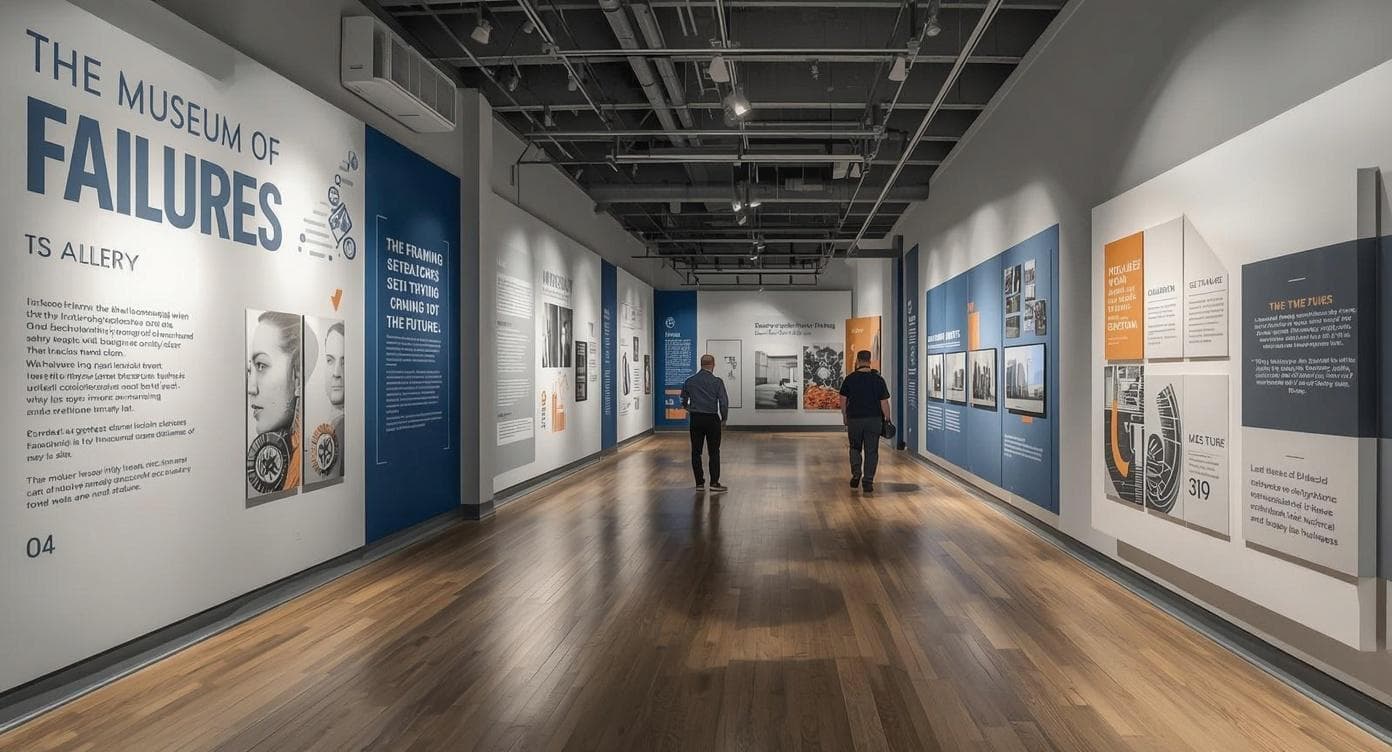
Every startup founder has a graveyard of ideas that didn’t ship, pivots that flopped, and ventures that never made it past Series A.
The question isn’t whether you’ll accumulate these experiences. The question is: are you building a Museum of Failures or a Gallery of Trying?
The distinction isn’t semantic. It’s strategic. And it determines whether your next venture will be bolder or smaller than your last.
The Museum Mindset in Business
Walk into any coworking space and you’ll meet founders curating their own Museum of Failures. They can recite every mistake with archaeological precision: the feature that users ignored, the partnership that imploded, the runway they miscalculated by three months.
Museums preserve what’s dead. They create static narratives with fixed meanings. In the Museum of Failures, that product launch that missed targets becomes permanent evidence that you “don’t understand the market.” The co-founder breakup becomes proof you “can’t evaluate people.” The burned investor relationship becomes a scarlet letter explaining why you “don’t deserve funding.”
The museum mindset treats each setback as a verdict rather than a variable. It asks: “What does this failure reveal about my fundamental inadequacy as a founder?”
This is how promising entrepreneurs talk themselves out of the game entirely.
The Gallery Perspective for Founders
Galleries operate on different principles than museums. They’re spaces of iteration, not finality. What hangs today gets replaced tomorrow. Interpretation evolves. The collection grows more sophisticated over time.
When you maintain a Gallery of Trying, that same failed product launch tells a different story. It’s not a tombstone it’s customer discovery. It’s data. It’s a $50K graduate degree in what your market actually wants versus what you assumed they wanted.
The Gallery of Trying reframes your startup journey as a body of work in progress. Each venture, whether it scaled or stalled, becomes part of your evolving expertise. The side project that never gained traction? That’s where you learned to build in public. The B2B pivot that didn’t work? That’s where you discovered enterprise sales cycles are real and brutal and non-negotiable.
Same experiences. Completely different strategic value.
Why This Matters for Your Next Venture
Here’s what founders miss: investors can smell a Museum of Failures from across the pitch deck.
When you frame your previous ventures as failures, you communicate uncertainty about your ability to execute. You apologize for your track record instead of leveraging it. You position yourself as someone who’s been defeated by the market rather than educated by it.
But when you curate a Gallery of Trying? You become a founder with pattern recognition. Someone who’s stress tested hypotheses in the real world. Someone who’s learned expensive lessons on someone else’s dime (or your own) and can now deploy that knowledge more efficiently.
Reid Hoffman didn’t hide SocialNet before building LinkedIn. He studied what didn’t work and built something better.
Stewart Butterfield didn’t bury Glitch before creating Slack. He extracted the most valuable asset from a failed gaming company and turned it into a $27B exit.
Sara Blakely didn’t hide her fax machine sales career before launching Spanx. She talked about the rejection, the door slamming, the learning to sell when no one wants to buy.
They all maintained Galleries of Trying.
The Operational Impact
This isn’t just about narrative. It affects how you build companies.
**Museum founders become risk-averse.** They’ve learned that trying things that might not work leads to more exhibits in their museum. So they optimize for avoiding failure rather than pursuing asymmetric upside. They build incrementally safer products. They take incrementally smaller swings. They say no to bold bets because their museum is already too crowded with evidence of what happens when bold bets don’t pay off.
**Gallery founders become antifragile.** Each venture regardless of outcome expands their capabilities. They’ve decoupled their self-worth from any single company’s trajectory. They can take bigger risks because they trust their ability to extract value from any outcome. The gallery can always accommodate another experiment.
This is why second-time founders outperform first-timers even when their first venture failed. They’ve shifted from museum to gallery thinking.
How VCs Actually Evaluate Failure
Here’s an insider secret: top-tier investors don’t care that your last startup failed. They care about what you learned and whether you’re applying it.
When a founder walks in and says, “My last company failed because I didn’t understand unit economics and hired too fast,” that’s museum thinking. It’s a static admission of inadequacy.
When a founder says, “My last company taught me that in B2B SaaS, CAC payback period matters more than vanity metrics, and I built the wrong team for product-market fit stage versus scaling stage here’s how I’m applying those lessons,” that’s gallery thinking. It’s dynamic learning converted to strategic advantage.
The second founder gets the meeting. The first founder gets ghosted.
Making the Shift: Practical Strategies
If you’ve been operating a Museum of Failures, here’s how to convert it into a Gallery of Trying:
Reframe your track record. Stop listing previous ventures as failures”on your LinkedIn. Start positioning them as built and learned from X or explored Y market, validated Z insights. Language shapes perception both others’ and your own.
Conduct a learning audit. For each previous venture, write down three specific, tactical things you learned that you couldn’t have learned any other way. This isn’t therapy. It’s strategic intelligence extraction.
Build in public about the process, not just the outcome. Share what you’re learning in real-time. Document hypotheses and test results. When something doesn’t work, explain what you learned and what you’re trying next. This positions you as a founder who iterates, not one who fails.
Tell better war stories. Every founder has narratives about their journey. Museum founders tell stories about what went wrong. Gallery founders tell stories about what they discovered. Same events, different framing, completely different positioning.
The Question Every Founder Should Ask
The next time a product flops, a hire doesn’t work out, or a funding round falls through, ask yourself: Am I adding this to a museum or a gallery?
Museum addition: This proves I can’t build products users want.
Gallery addition: This taught me that my target customer isn’t who I thought it was, and here’s what I’m testing next.
One compounds into paralysis. The other compounds into pattern recognition.
The Unfair Advantage
Here’s the truth about entrepreneurship: the founders who win aren’t the ones who never fail. They’re the ones who extract the most value from each attempt.
Your museum is a liability. It’s dead weight. It’s why your next venture will be smaller and safer than your last.
Your gallery is an asset. It’s accumulated knowledge. It’s why your next venture can be 10x more ambitious than your last.
You’re going to have setbacks. You’re going to build things that don’t scale. You’re going to misjudge markets and misread signals and miscalculate burn rates.
The only question is: what kind of institution are you building to house those experiences?
Choose the gallery. Build the next thing. Keep trying.
That’s how you win the long game.